
Secondary funds as a strategic portfolio tool: From liquidity to program implementation
As the secondary market grows in scale and sophistication, secondary funds are moving beyond their traditional role as a source of liquidity. For institutional investors, they can offer a practical way to build, diversify and manage private-markets exposure with greater flexibility and efficiency.

The secondaries market: From niche to institutional scale
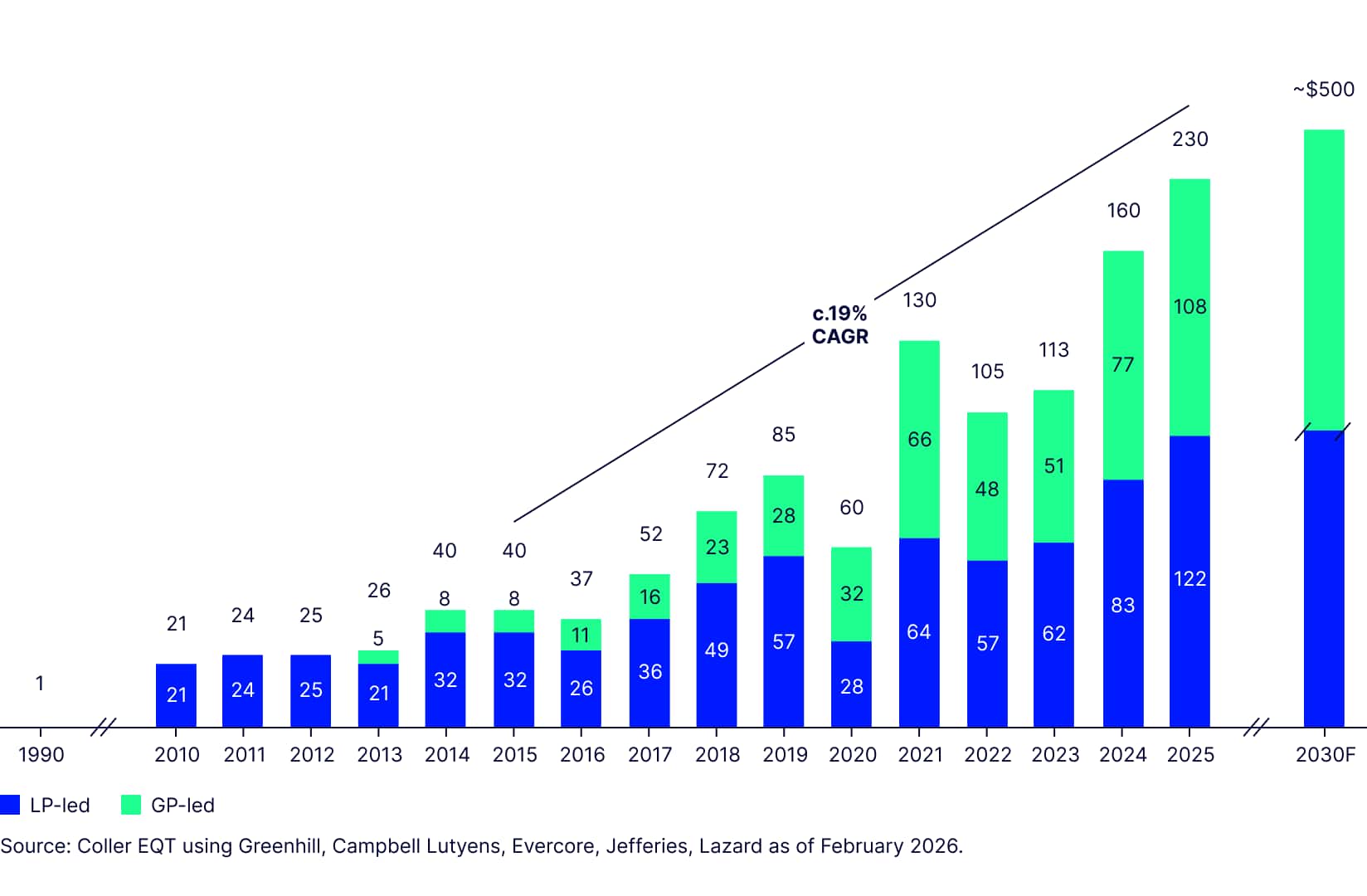
The secondaries market has experienced significant growth over the past decade, reaching an estimated $230 billion of transaction volume in 2025, more than 40% above the prior year and a record for the asset class. This momentum is expected to continue, with assets under management across secondary strategies projected to more than double by 2030.1
This shift happened alongside an important change in perception: the secondary market has evolved from being perceived as a venue where distressed and forced sellers offload assets, to a strategic tool for portfolio rebalancing, cash-flow management and allocation decisions.
| Secondary transaction | Secondary fund |
| The purchase of an existing private-markets interest or asset after the original commitment has been made. Price is negotiated by reference to reported net asset value (NAV). | A dedicated vehicle that acquires these interests and assets, building a portfolio diversified across managers, vintages, sectors and, increasingly, asset classes. |
| LP-led transaction | GP-led transaction |
|
|
Source: State Street Investment Management.
Its evolution and maturity are also reflected in the market’s increasingly diversified composition, both by transaction type—with GP-led transactions now representing almost half of transaction volume2—and by strategy, as fast-growing areas such as credit, infrastructure, and venture secondary funds emerge as their respective primary markets grow, deepen, and mature.
For many institutional investors, access to this opportunity set is most practically achieved through dedicated secondary funds, which can provide diversified exposure across transaction types, managers, vintages, and strategies.
The expansion of the secondaries market historically has been driven in part by a more challenging exit environment across private markets, with liquidity and limited exit routes cited as the leading concern by 80% of institutional investors, alongside asset-valuation considerations and broader portfolio-management needs.3
Figure1: Secondary market assets under management and GP-led and LP-led shares (1990-2030F)
Beyond liquidity: The portfolio role of secondaries
At this stage of the market’s evolution, the case for allocating to secondary funds extends beyond the market’s traditional association with liquidity provision. The diversification, implementation efficiency, cash-flow management, and portfolio-construction disciplines that have long shaped public-market investing can now be applied more deliberately to private markets, with secondary funds providing one of the most effective tools to support that transition.
Increasingly, secondary fund strategies are being used as practical tools to help investors construct, manage, and expand private markets programs.
1 Portfolio Construction
2 Program Management
3 Portfolio Access
Note: The benefits covered in this paper primarily refer to allocations to, or investments in, secondary funds.
Figure 2: Summary of portfolio benefits of secondary funds
| Portfolio construction | Portfolio management | Portfolio access |
|
|
|
Source: State Street Investment Management. Non-exhaustive list of benefits, for illustrative purposes only. As of August 2026.
1. Portfolio construction
From a portfolio-construction perspective, secondaries can complement primary commitments by helping investors design private markets allocations more deliberately. By providing exposure to more mature assets, diversified vintage years, and a broader mix of managers, sectors and strategies, secondary funds could possibly reduce reliance on any single commitment cycle while potentially mitigating concentration risk.
In practice, a single allocation to a secondary fund can provide access to more than 200 GPs across different strategies, more than 10 vintage years and several thousand companies globally.4 This could make secondaries a useful complement to traditional primary commitments for allocators seeking to build more balanced and resilient private-markets portfolios over time.
Figure 3: Look-through comparison of primary fund and secondary fund commitment
| Primary fund commitment | Secondary fund commitment | |
| GP | One | >200 |
| Strategy | One |
|
| Geography | Single, country, pan-regional, global | Global (US, Europe, APAC) |
| Sectors/Niches | 1—Many | All |
| Type of deal | Single companies only |
|
| # of companies | 8-20 | >3,000 |
| Vintage year | One-c. 5 investment years | >10 |
Source: State Street Investment Management, based on the typical features of a primary mid-market fund with a max. of 20 portfolio companies and Coller EQT flagship fund series. For illustrative purposes only. As of August 2026.
2. Program management
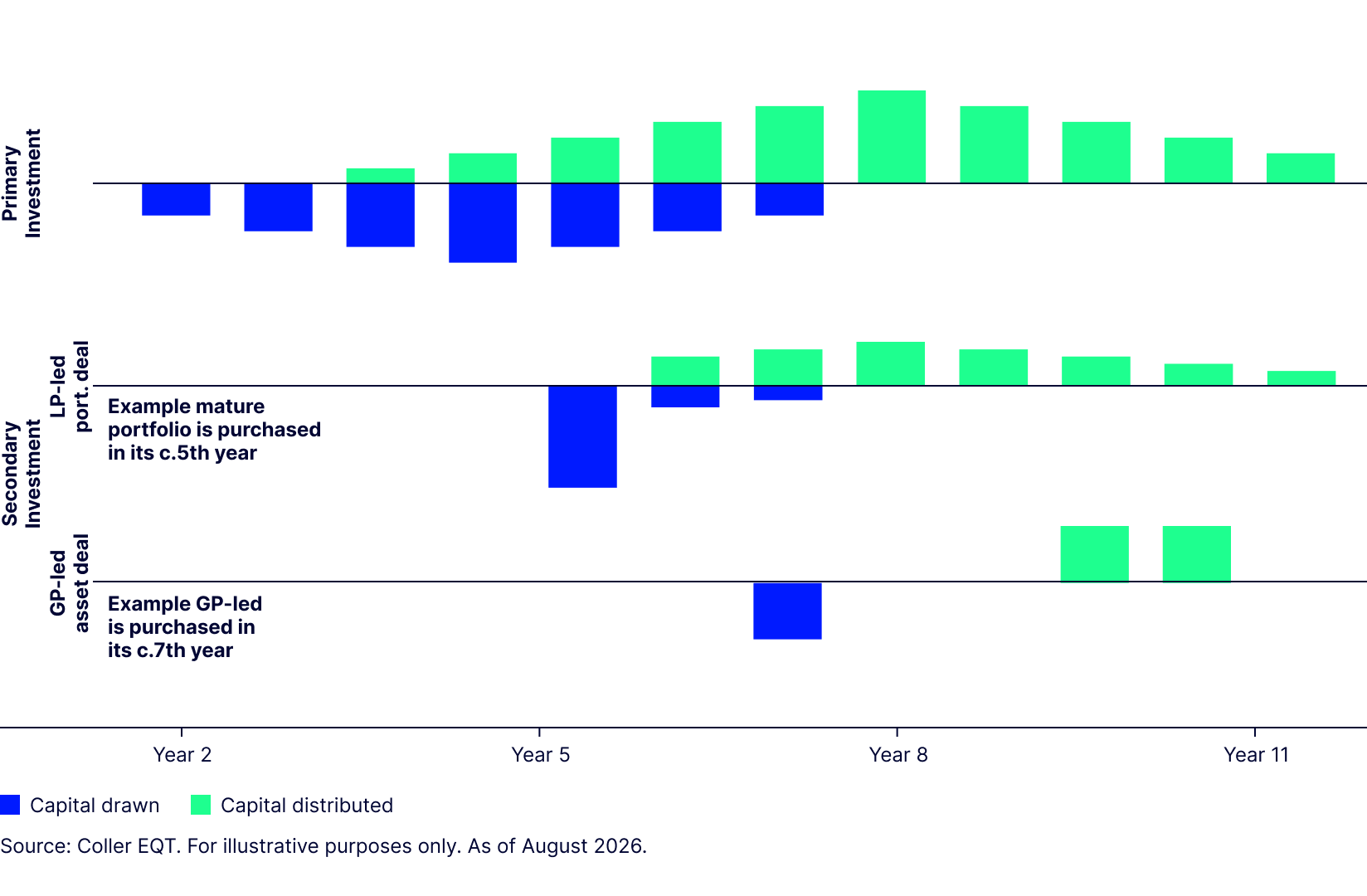
Allocations to secondary funds can help allocators manage private markets programs more efficiently. Compared with primary commitments, secondary funds can often accommodate larger average commitment size5 while maintaining attractive diversification, allowing investors to deploy capital more quickly, and scale their programs with greater operational efficiency. This can be particularly valuable for allocators seeking to build exposure rapidly with limited investment resources. Secondaries can also help balance new commitments against distributions and create a more flexible cash flow profile than primary-only programs.
Figure 4: Cash-flow profile of primary and secondary fund investments
3. Portfolio access
The diversified exposures available through LP-led portfolios and GP-led transactions within secondary funds can enable allocators to access strategies, managers, and geographies that may otherwise be difficult for institutional investors to source directly. This is particularly relevant for balanced secondary funds with a meaningful allocation to GP-led transactions, which are often bilaterally negotiated, require extensive due diligence, and may be difficult for many allocators— particularly smaller institutions—to access on a standalone basis.
Private credit secondaries can further broaden portfolio access by providing exposure to seasoned credit portfolios, potentially offering more compelling entry points, reducing blind-pool risk, and accelerating deployment relative to primary commitments.
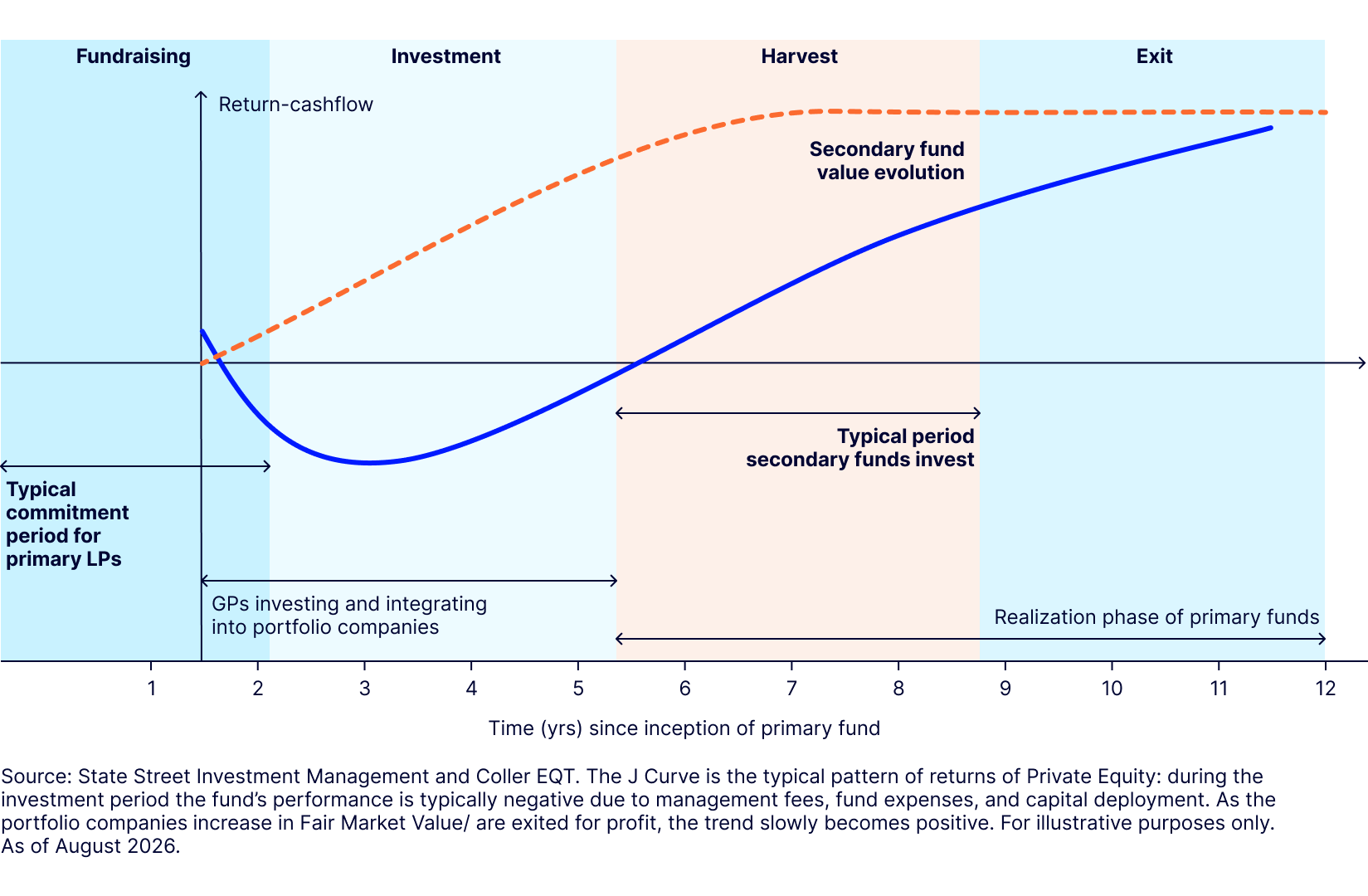
Finally, investing through a secondary fund can provide exposure to more mature assets, where value creation is already more visible and expected holding periods may be shorter.
Figure 5: The J-curve mitigation of secondaries
Implementing secondary funds in an investor portfolio
For investors, the practical question is no longer whether secondaries could provide liquidity to the private-markets ecosystem, but how they could be incorporated into portfolio design and program management. Used deliberately, allocations to secondary funds may sit alongside primary commitments as a tool to scale exposure, manage pacing, reduce concentration and improve visibility on underlying assets and cash flows.
Defining the role of secondary funds by investor type
The role of secondary funds will vary depending on an investor’s starting point, program maturity and level of sophistication.
Investors building a new or underweight private markets allocation may use secondary funds to shorten the ramp-up period and reduce the blind-pool exposure typically associated with primary commitments. More mature programs may use secondaries to rebalance exposures, support more disciplined commitment pacing, enhance cash-flow visibility, complement distributions and improve capital efficiency. In each case, the objective should be to define the role of secondary funds within the overall allocation, rather than treating them as a standalone or purely opportunistic sleeve.
Implementation strategies should then reflect that role.
For investors entering private markets for the first time, secondary funds can provide a practical way to begin building exposure immediately, offering diversified access through a single commitment in a cost-effective and resource-efficient manner. For investors with larger and more sophisticated programs, implementation should begin with a more detailed review of the existing portfolio, assessing current exposure by strategy, vintage year, manager, geography and liquidity profile, and identifying where secondary funds can address specific gaps.
In private equity, this may mean adding exposure to more mature assets, increasing diversification across vintages and managers, or adjusting exposure to specific sectors and regions. In private credit, secondary funds may help investors access seasoned loans and portfolios, accelerate deployment and manage concentration as programs grow.
Manager selection and due diligence
Manager selection is central to implementation. Investors should assess the breadth and quality of a manager’s access to LP-led and GP-led opportunities, as well as the intended balance between these exposures within the proposed fund.
Key diligence areas should include the length, quality and consistency of the track record; specialist expertise across equity and credit; underwriting, valuation and pricing discipline; portfolio construction and risk management; and the operational infrastructure required for institutional reporting, monitoring and execution.
Investors should also assess the fee structure in the context of expected net returns, cash-flow characteristics and the role of the fund within the overall private markets allocation, as higher fees need to be justified by the value delivered at portfolio level.
The ability to source, diligence and structure transactions is particularly important in areas of the market that are less accessible to individual allocators, including complex GP-led transactions and segments such as credit secondaries.
Building more flexible private markets portfolios with secondary funds
In summary, secondary funds should be viewed as a strategic component of the private markets toolkit, rather than being seen solely through the lens of liquidity.
By combining primary fund commitments with equity and credit secondary fund strategies, investors can build, scale, diversify and manage private markets exposure with greater flexibility over time, while also supporting cash-flow planning, commitment pacing and capital efficiency. The implementation challenge is to define the role of secondary funds within the overall allocation, determine the right mix for the portfolio, align it with cash-flow needs and governance resources, and select managers capable of executing across a broad and increasingly specialized secondaries market.